US-China Leaders to Meet in September Amid Talks on Tariff Reductions
September 11, 2026 at 2:30 AM1 min read

AI Summary
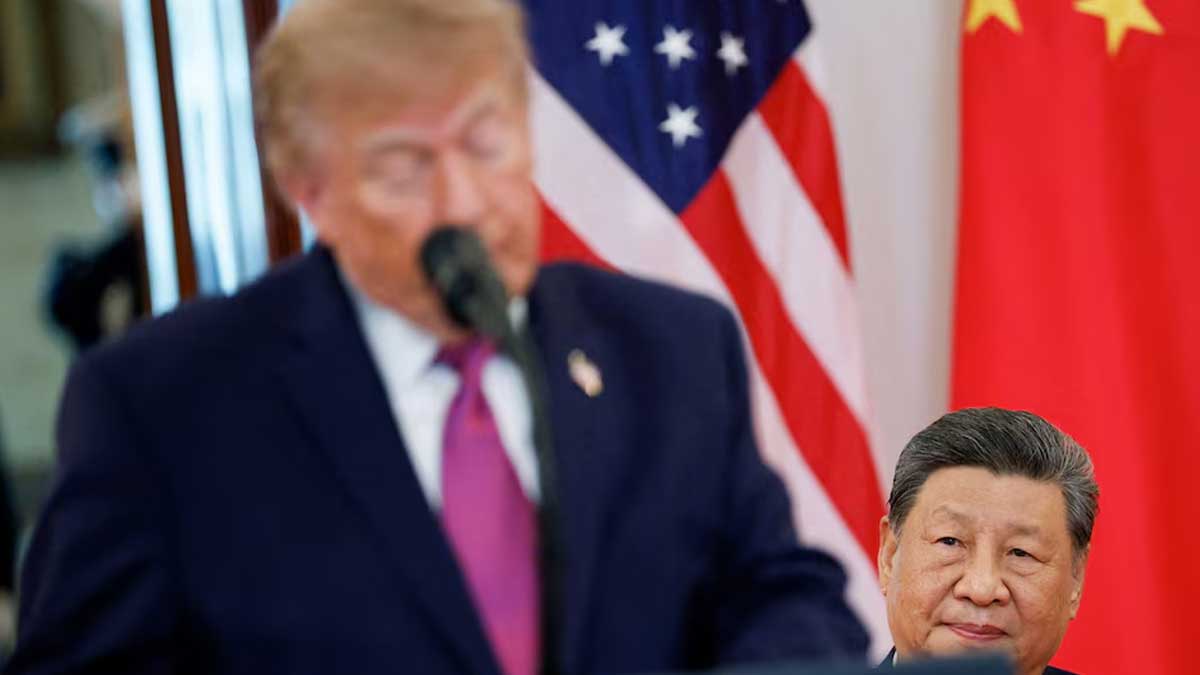
US President Donald Trump and Chinese leader Xi Jinping are scheduled for a third face-to-face summit in Washington on September 24. Ahead of this meeting, both nations are expected to negotiate an agreement focused on lowering import taxes. A Commerce Ministry spokesperson stated that negotiators are attempting to implement tariff reductions on $30 billion of goods at an early date. Officials from both countries described the upcoming meeting as an effort to stabilize bilateral ties amidst intense strategic competition between the world’s two largest economies.
World View
2 perspectivesPakistan's perspective
The News International
The news coverage highlights that US President Donald Trump and Chinese leader Xi Jinping are scheduled for their third face-to-face summit in Washington on September 24. Ahead of this meeting, there is anticipation regarding a tariff agreement focused on lowering import taxes, with negotiators reportedly aiming to implement reductions on $30 billion worth of goods soon. Officials from both nations view the upcoming talks as crucial efforts to stabilize bilateral relations amid intense strategic competition between the two major economies. Furthermore, Chinese sources emphasize that high-level diplomacy plays an irreplaceable role in guiding China-US relations.
Turkey's perspective
Daily Sabah
US President Donald Trump and Chinese leader Xi Jinping are scheduled for a third face-to-face summit in Washington on September 24. Ahead of this meeting, both nations are expected to negotiate an agreement focused on lowering import taxes. A Commerce Ministry spokesperson stated that negotiators are attempting to implement tariff reductions on $30 billion of goods at an early date. Officials from both countries described the upcoming meeting as an effort to stabilize bilateral ties amidst intense strategic competition between the world’s two largest economies.
The Hidden Strings
Patterns visible only when every country's coverage is placed side by side — the connections no single source draws.
Vocabulary
The Vocabulary String: Mutual Effort vs. Dependent Action
95%
Sources use fundamentally different language to describe the diplomatic process. Cluster A employs hopeful, collective terms like 'fueling expectations' and 'eye tariff cuts,' suggesting a shared path toward resolution. Conversely, Cluster B uses verbs of necessity and dependency, such as 'china seeks' and 'expected to reach a tariff agreement,' framing China as the party requiring external concessions.
'eye tariff cuts' used by [Mutual diplomatic effort toward resolution]'fueling expectations' used by [Mutual diplomatic effort toward resolution]'china seeks' used by [China's dependence on US concessions]'expected to reach a tariff agreement' used by [China's dependence on US concessions]
Frame Inversion
The Frame Inversion: Joint Effort vs. Concession Dependency
90%
Cluster A presents the narrative as a balanced, mutual diplomatic effort involving multiple parties working toward an agreement. Cluster B inverts this frame by focusing exclusively on China's need for US concessions, thereby shifting the agency and power dynamic away from 'mutual resolution' to one of explicit dependency.
Cluster A: 'Mutual diplomatic effort toward resolution'Cluster B: 'China's dependence on US concessions'
Timing
The Timing String: Optimism to Urgency Shift
85%
The publication timeline reveals a rapid shift in narrative focus. The earlier report (Turkey, 10:25) establishes general diplomatic optimism and expectation of mutual progress. The subsequent report (Pakistan, 10:38), published just minutes later, immediately narrows the focus to an urgent, specific dependency angle regarding China's need for US concessions.
2026-09-10T10:25 Turkey Daily Sabah2026-09-10T10:38 Pakistan The News International
How Each Side Framed It
Mutual diplomatic effort toward resolution
Turkey
Neutral; presents negotiations as a shared goal for both nations.
eye tariff cutsfueling expectationsagreement
China's dependence on US concessions
Pakistan
Slightly favors the narrative of Chinese need and action.
china seeksexpected to reach a tariff agreement
What Mainstream Coverage Missed
Angles present in the cross-border material that the dominant coverage buried or skipped.
- The rapid shift in diplomatic focus from general 'mutual progress' to an urgent, specific dependency angle within minutes.
- The explicit linguistic contrast between describing the process as a shared 'mutual effort' versus framing it through verbs of necessity and external 'concessions.'
- The underlying power dynamic suggested by the media: whether the narrative is designed to emphasize joint resolution or China’s need for US economic action.
The Beyond the Borders PoV
The Question
Should the US and China prioritize achieving tariff reductions on $30 billion of goods during their September summit to stabilize bilateral economic ties?
The US and China should prioritize achieving tariff reductions on $30 billion of goods during their September summit to stabilize bilateral economic ties.
Officials view the upcoming meeting between Donald Trump and Xi Jinping as a critical effort to stabilize bilateral relations amidst intense strategic competition. Furthermore, negotiators are already aiming to implement tariff reductions totaling $30 billion at an early date. Given that the current truce on tariff hikes expires soon, achieving this reduction is necessary to prevent economic instability.
Achieving a significant tariff agreement is crucial for stabilizing bilateral ties because officials have already framed the summit as an effort to manage intense strategic competition between the two world economies. This suggests that concrete progress on trade issues, such as lowering import taxes, is viewed by both nations as essential to prevent broader economic conflict.
Prioritizing the $30 billion reduction is necessary because the current tariff truce expires on November 10, making an early agreement a time-sensitive requirement to maintain economic stability and prevent immediate trade disruptions.
The summit provides a necessary platform for this agreement, as Donald Trump and Xi Jinping are scheduled to meet in Washington on September 24, offering the most immediate opportunity to finalize the tariff reductions before other economic pressures mount.
These are AI-generated arguments built from the evidence available across the source material. They do not imply that any publisher endorses either position.
Disclaimer
The summary and perspectives above are AI-generated from the source articles listed below. They may contain errors or omissions. Always verify with the original sources. Beyond the Borders is a news aggregation platform and does not produce original journalism.
How does this story make you feel?
What each source is saying
2 sourcesTheir Angle
China and the United States are expected to reach a tariff agreement based on lowering import taxes soon ahead of a highly anticipated summit between President Trump and Chinese leader Xi Jinping.
Full Article
US President Donald Trump and Chinese leader Xi Jinping are slated to hold their meeting in September China and the United States are expected to reach a tariff agreement based on lowering import taxes soon ahead of a highly anticipated summit between President Trump and Chinese leader Xi Jinping this September. According to Commerce Ministry spokesperson Huang Ling, the negotiators are trying to implement tariff reductions on $30 billion of goods at an early date. However, she did not disclose the definite timeline of agreement which Ling hoped about reaching with Washington. The announcement comes after it is widely expected that leaders of both countries could meet in two weeks. US President Donald Trump and Chinese leader Xi Jinping are slated to hold their third face-to-face summit of the past year in Washington on September 24. Without providing further details, officials from both nations describe the upcoming meeting as an effort to stabilize bilateral ties amidst intense strategic competition between the world’s two largest economies. Chinese Foreign Ministry spokesperson Guo Jiakun said Thursday, “the leaders’ diplomacy plays an irreplaceable strategic guiding role in China-U. S. relations." Last May, both leaders met in Beijing and during the talks they agreed to launch a US-China Board of Trade aimed at managing trade between two nations along with a parallel Board of Investment. The agreement was seen as a truce between countries’ trade war initiated by Trump’s imposed tariffs on Chinese imports. Later China also retaliated. “Trade will be front and center at the summit,” Barclays Bank said in a research note this week on the upcoming Trump-Xi meeting. However, the truce on tariff hikes is going to expire on November 10. But as per analysis, the prospects of reaching broad trade deals are dimmed and targeted tariff reductions are more likely.
More from business


PreviousbusinessUK Defends Sanctions on Trade with Israeli Settlements in Occupied West BankNextbusinessU.S. Stocks Fall Amid Oil Price Surge and Rate Hike Concerns
Discussion
Leave a comment