businessCovered by 2 Sources
US and China Announce Tariff Reduction Lists After High-Level Meetings
September 28, 2026 at 2:30 PM1 min read

AI Summary
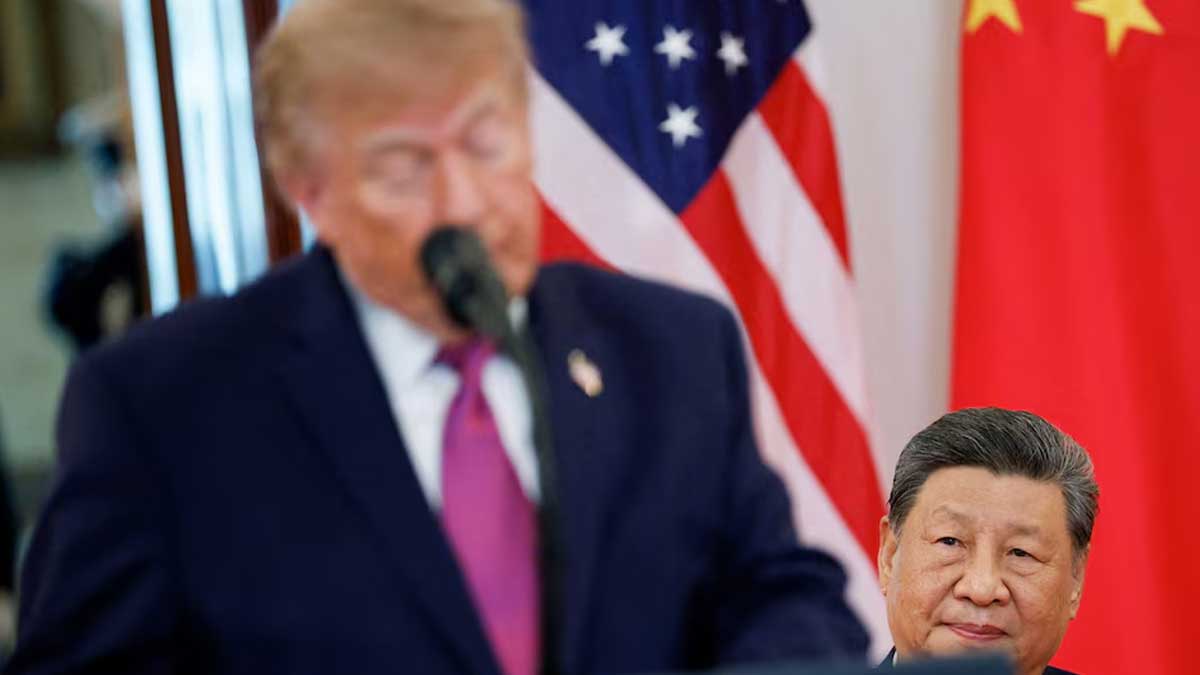
The United States and China released lists of products for which they plan to reduce import tariffs against each other. This development followed President Donald Trump hosting his counterpart Xi Jinping in Washington. China's Ministry of Commerce stated that the tariff reductions on selected products will be implemented by the U. S. and China simultaneously, though no specific date was provided. The lists include items such as Christmas ornaments, lumber, and camels. The expected tariff relief is described as one of the most tangible outcomes of Xi Jinping's state visit to Washington.
World View
1 perspectiveJapan's perspective
Nikkei AsiaJapan Times
A container ship docked at Yangshan Port outside of Shanghai in 2025. China's Ministry of Commerce says the U. and China will implement tariff reductions on selected products "simultaneously," but did not specify a date. © Reuters SHANGHAI -- The U. and China on Monday released lists of items on which they plan to reduce import tariffs against each other, days after President Donald Trump hosted his counterpart Xi Jinping in Washington.
The Hidden Strings
Patterns visible only when every country's coverage is placed side by side — the connections no single source draws.
Vocabulary
The Vocabulary String: Procedural Mechanics vs. Diplomatic Grandeur
100%
The sources employ radically different vocabularies to describe the same event. Cluster A uses highly technical, operational terms like 'ministry of commerce,' 'implement,' and 'selected products.' Conversely, Cluster B relies on abstract, high-stakes language such as '$30 billion tariff deal,' 'tangible outcomes,' and 'state visit.' This contrast suggests a deliberate framing choice: one narrative emphasizes the bureaucratic effort, while the other emphasizes the geopolitical success.
ministry of commerce / selected products / implement (Cluster A)tangible outcomes / $30 billion tariff deal / state visit (Cluster B)Contrast table
Silence
The Silence String: Omission of Procedural Friction
95%
The diplomatic narrative (Cluster B) completely omits any mention of the complex, day-to-day mechanics of trade, such as the need for 'ministry of commerce' involvement or the specific process of 'implementing' tariff cuts. The focus is solely on the final, clean outcome, effectively silencing the procedural friction and bureaucratic difficulty inherent in the agreement.
Cluster B omitting 'ministry of commerce' and 'implement'Cluster A detailing 'selected products' and 'tariff reductions'Contrast table
Timing
The Timing String: Diplomatic Success Precedes Operational Detail
90%
The publication timeline reveals a clear sequencing of narrative framing. The Japan Times (Cluster B) reports the high-level, positive diplomatic outcome ($30 billion deal) at 05:31. The Nikkei Asia (Cluster A) reports the granular, itemized details (ornaments, lumber, tariff cuts) later at 06:00. This suggests that the overarching diplomatic narrative was prioritized and released first, framing the subsequent procedural details.
2026-09-28T05:31 Japan Japan Times2026-09-28T06:00 Japan Nikkei Asia
How Each Side Framed It
Procedural details of trade agreement implementation
Japan
Neutral, focusing on the mechanics and logistics of the trade deal.
tariff reductionsselected productsministry of commercesimultaneously
Diplomatic success resulting from high-level talks
Japan
Favors the diplomatic effort, highlighting the positive outcome of the meeting.
$30 billion tariff dealtangible outcomesstate visit
What Mainstream Coverage Missed
Angles present in the cross-border material that the dominant coverage buried or skipped.
- The actual items subject to tariff reduction, such as Christmas ornaments, lumber, and camels, are relegated to secondary detail, minimizing their importance relative to the high-stakes diplomatic language.
- The procedural friction of the agreement, requiring the involvement of the 'Ministry of Commerce' and the complex process of 'implementing' cuts, is entirely omitted from the diplomatic narrative.
- The publication timeline suggests a deliberate narrative sequencing: the overarching diplomatic success was prioritized and released first, framing the subsequent, granular operational details.
The Beyond the Borders PoV
The Question
Should the US and China proceed with the announced tariff reductions on specific product lists (e.g., Christmas ornaments, lumber, camels) to facilitate broader economic cooperation?
The US and China should proceed with the announced tariff reductions to facilitate broader economic cooperation.
The US and China have released product lists for a $30 billion tariff deal, including items like Christmas ornaments, lumber, and camels. These reductions were announced shortly after a high-level meeting between President Donald Trump and Xi Jinping. Proceeding with these tariff cuts signals a commitment to de-escalate trade tensions, which is necessary for fostering broader economic cooperation.
The establishment of a large-scale, multi-product tariff deal, valued at $30 billion, demonstrates a significant political will and mutual commitment from both nations to stabilize trade relations, making the continuation of these reductions a necessary step toward broader economic cooperation.
The timing of the tariff reductions, announced immediately following a meeting between President Donald Trump and Xi Jinping, suggests that these cuts are a direct, high-level diplomatic outcome intended to build trust and facilitate deeper economic engagement between the two countries.
The specific nature of the product lists, which include diverse goods like Christmas ornaments, lumber, and camels, indicates that the cooperation is not limited to a few strategic sectors but aims to normalize trade across a wide range of consumer and industrial goods, thereby supporting comprehensive economic integration.
These are AI-generated arguments built from the evidence available across the source material. They do not imply that any publisher endorses either position.
Disclaimer
The summary and perspectives above are AI-generated from the source articles listed below. They may contain errors or omissions. Always verify with the original sources. Beyond the Borders is a news aggregation platform and does not produce original journalism.
How does this story make you feel?
What each source is saying
2 sourcesTheir Angle
US and China list Christmas ornaments, lumber, camels for tariff cuts
Article Preview
A container ship docked at Yangshan Port outside of Shanghai in 2025. China's Ministry of Commerce says the U. S. and China will implement tariff reductions on selected products "simultaneously," but did not specify a date. © Reuters SHANGHAI -- The U. S. and China on Monday released lists of items on which they plan to reduce import tariffs against each other, days after President Donald Trump hosted his counterpart Xi Jinping in Washington.
More from business


Discussion
Leave a comment