France announces localized curfews and security measures following weekend unrest
October 20, 2026 at 2:08 AM1 min read

AI Summary
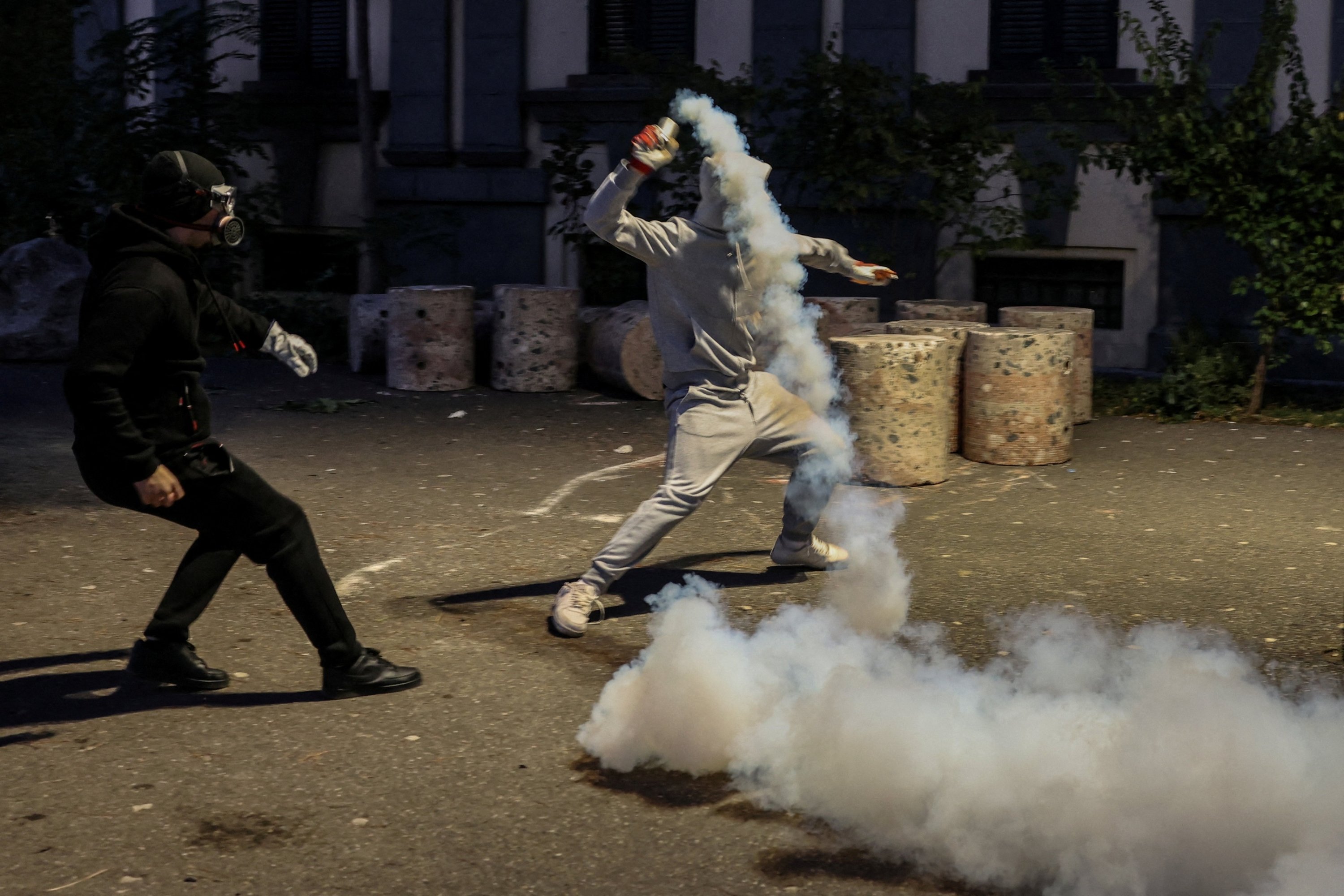
Following a weekend of violence and looting, the French government announced localized curfews, financial support for affected businesses, and a tougher judicial response. The unrest began after student protests over living conditions erupted into violence last Saturday. During the unrest, the Paris prosecutor’s office reported 855 arrests, with 557 people placed in police custody. President Emmanuel Macron addressed the nation, condemning the violence and announcing new operational procedures for security forces. The Yellow Vests movement planned further demonstrations for the following weekend.
World View
2 perspectivesFrance's perspective
France24
Following a weekend of #violence and #looting, the French government has announced localised #curfews, financial support for affected businesses and a tougher judicial response, while keeping the option of a state of emergency on the table.
EU's perspective
Euronews
The EU coverage frames Macron's presidency as facing mounting social and political criticism amid the unrest. It reports that the protests, which began after student demonstrations over living conditions, led to 855 arrests and 557 people placed in custody. Macron addressed the nation, condemning the violence and announcing new operational procedures for security forces. The reporting also contextualizes the unrest by mentioning that the Yellow Vests movement plans a 'second act' for the following weekend, all while noting Macron's low approval rating in a recent poll.
The Hidden Strings
Patterns visible only when every country's coverage is placed side by side — the connections no single source draws.
Vocabulary
The Vocabulary String: Political Failure vs. State Control
100%
The two clusters use diametrically opposed vocabulary to describe the same underlying event. Cluster B frames the situation using terms of political decline ('unrest,' 'deepened macron’s political isolation'), while Cluster A uses terms of immediate, physical control ('localised curfews,' 'state of emergency,' 'violence'). This contrast allows the narrative to be simultaneously about political weakness and necessary state force.
unrest used by [Political instability and leadership failure] but ABSENT in [State response to restore public order]localised curfews used by [State response to restore public order] but ABSENT in [Political instability and leadership failure]deepened macron’s political isolation used by [Political instability and leadership failure] but ABSENT in [State response to restore public order]
Silence
The Silence String: Omission of Causality
95%
Both clusters engage in selective omission regarding the root cause and the immediate solution. Cluster B (Political Instability) focuses on Macron's weakness but is silent on the specific, localized nature of the curfews. Conversely, Cluster A (State Response) details the curfews and financial support but is silent on the underlying political failure or the depth of Macron's isolation.
Cluster A mentions 'localised curfews' but omits 'deepened macron’s political isolation.'Cluster B mentions 'deepened macron’s political isolation' but omits 'localised curfews.'
Timing
The Timing String: Instability Precedes Action
90%
The reporting timeline suggests that the narrative of political decline and leadership failure was established and published 20 minutes before the concrete announcement of state security measures. Euronews (16:38) sets the stage by focusing on Macron's isolation, while France24 (16:44) reports the physical manifestation of the crisis (curfews and violence).
2026-10-19T16:38 EU Euronews: Macron increasingly isolated amid unrest across France2026-10-19T16:44 France France24: France: ‘localised’ curfews announced after weekend of violence
How Each Side Framed It
State response to restore public order
France
Favors the government and state authority by highlighting decisive action.
localised curfewsfinancial supporttougher judicial responsestate of emergency
Political instability and leadership failure
EU
Critiques the political leadership by focusing on its declining authority.
increasingly isolatedunrestdeepened macron’s political isolationraising questions over his authority
What Mainstream Coverage Missed
Angles present in the cross-border material that the dominant coverage buried or skipped.
- The narrative of political decline (Macron's isolation) was established and published 20 minutes before the concrete announcement of localized curfews and security measures.
- The political critique (EU/Bloc) selectively omits the specific, localized nature of the curfews, treating the state response as a generalized act of force rather than a targeted measure.
- The simultaneous use of 'political failure' and 'state control' vocabulary allows the narrative to maintain the appearance of both systemic weakness and necessary immediate force.
The Beyond the Borders PoV
The Question
The French government's combination of localized curfews, financial support for affected businesses, and a tougher judicial response is the most effective strategy for restoring public order and stability following civil unrest.
The French government's combination of localized curfews, financial support for affected businesses, and a tougher judicial response is the most effective strategy for restoring public order and stability following civil unrest.
Following a weekend of violence and looting, the French government has implemented a multi-pronged response that includes localized curfews, financial support for affected businesses, and a tougher judicial response. Furthermore, the government maintained the option of declaring a state of emergency. This combination of measures suggests a comprehensive approach designed to address both the immediate security threat and the underlying economic damage caused by the unrest.
The combination of localized curfews and a tougher judicial response directly addresses the immediate threat of public disorder, making the strategy necessary for restoring basic public safety.
By including financial support for affected businesses, the government addresses the economic fallout of the unrest, which is crucial for long-term stability and recovery beyond merely restoring order.
The retention of the option for a state of emergency provides a necessary escalation mechanism, ensuring that the government retains maximum flexibility to respond if the initial measures prove insufficient to restore order.
These are AI-generated arguments built from the evidence available across the source material. They do not imply that any publisher endorses either position.
Disclaimer
The summary and perspectives above are AI-generated from the source articles listed below. They may contain errors or omissions. Always verify with the original sources. Beyond the Borders is a news aggregation platform and does not produce original journalism.
How does this story make you feel?
What each source is saying
2 sourcesTheir Angle
Following a weekend of #violence and #looting, the French government has announced localised #curfews, financial support for affected businesses and a tougher judicial response, while keeping the option of a state of emergency on the table.
Article Preview
Following a weekend of #violence and #looting, the French government has announced localised #curfews, financial support for affected businesses and a tougher judicial response, while keeping the option of a state of emergency on the table.
More from world

world
French Riots Lead to Detentions and Investigations Following Weekend Violence
about 2 hours ago · 2 sources
world
Unrest and Riots Reported Across Multiple European Countries
about 2 hours ago · 2 sources
world
French and UAE Presidents Discuss Cooperation, Energy, and Regional Security
about 2 hours ago · 2 sources
Discussion
Leave a comment