worldCovered by 3 Sources
Macron Declines Minister's Resignation After French Protests
October 19, 2026 at 3:22 PM1 min read

AI Summary
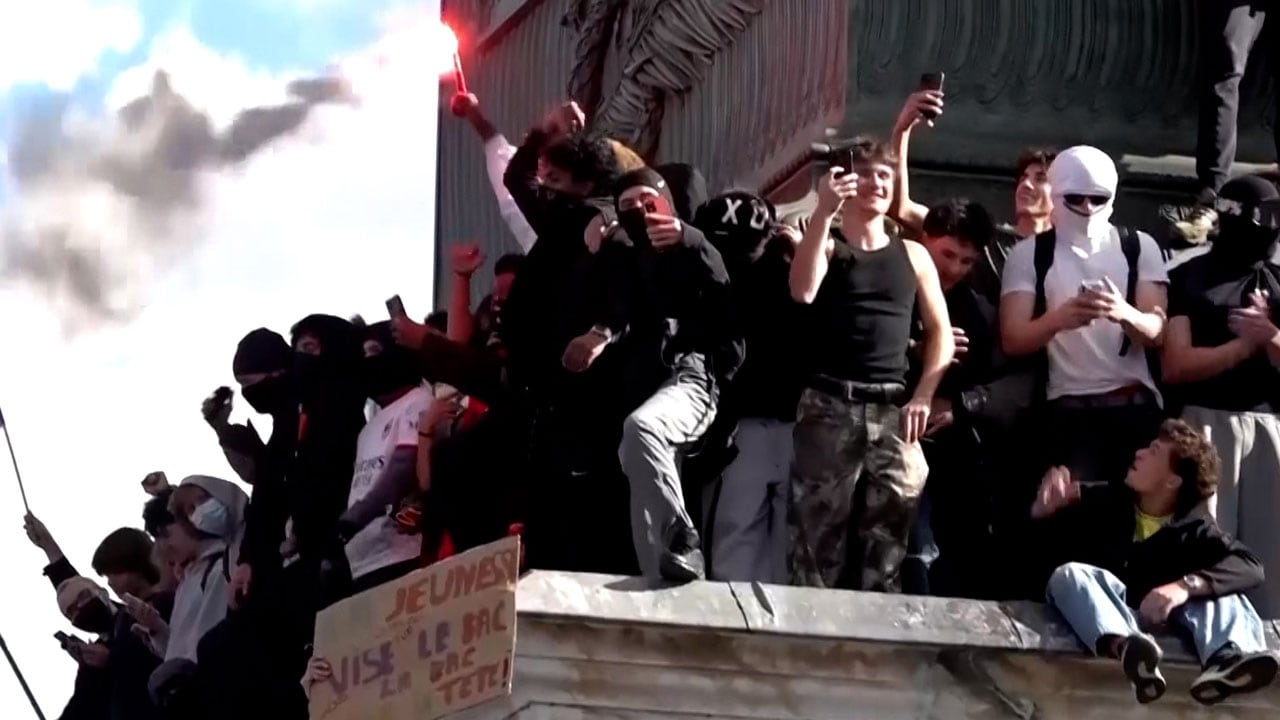
Following violent protests in France, President Macron declined the resignation of the Interior Minister. Laurent Nunez, the Interior Minister, acknowledged that police 'lost control' during the weekend protests. This admission was made during a crisis meeting in Paris, involving other ministers like Edouard Geffray and Philippe Baptiste. The protests occurred over a weekend, leading to political recriminations and authorities admitting that police botched oversight. Macron's decision to reject the resignation followed the unrest.
World View
3 perspectivesUK's perspective
Financial Times
Following violent protests in France, President Macron declined the resignation of the Interior Minister. Laurent Nunez, the Interior Minister, acknowledged that police 'lost control' during the weekend protests. This admission was made during a crisis meeting in Paris, involving other ministers like Edouard Geffray and Philippe Baptiste. The protests occurred over a weekend, leading to political recriminations and authorities admitting that police botched oversight. Macron's decision to reject the resignation followed the unrest.
Qatar's perspective
Al Jazeera English
Al Jazeera English reports that following the violent protests, President Macron declined the resignation of the Interior Minister. The coverage highlights that Interior Minister Laurent Nunez acknowledged that police 'lost control' during the weekend protests, an admission made during a crisis meeting in Paris.
France's perspective
Le Monde (English)
Laurent Nuñez acknowledged a 'lack of anticipation' in the deployment of security forces during Saturday's nationwide demonstrations, which were marred by large crowds of rioters and looters on the fringes.
The Hidden Strings
Patterns visible only when every country's coverage is placed side by side — the connections no single source draws.
Vocabulary
The Spectrum of Failure: From Operational to Political
95%
The reporting uses distinct vocabulary to categorize the failure, moving from tactical failure to institutional failure. Cluster C focuses on operational shortcomings using terms like 'lack of anticipation' and 'rioters and looters on the fringes.' In contrast, Cluster A elevates the discussion to high-level political failure using 'political recriminations' and 'political.' Cluster B frames the issue as a state control failure, emphasizing 'violent protests' and 'lost control.'
Cluster A: political recriminations, politicalCluster B: violent protests, lost controlCluster C: lack of anticipation, rioters and looters on the fringes
Silence
The Operational Scope is Localized
90%
The specific details regarding the physical scope of the unrest, such as 'rioters and looters on the fringes' and 'lack of anticipation,' are confined exclusively to the local source, Le Monde. The international clusters (FT and Al Jazeera) focus entirely on the political fallout (resignation, rejection, state control) and omit any mention of the operational details or the limited scope of the violence.
Cluster C: rioters and looters on the fringes, lack of anticipationCluster A: (Absence of operational detail)Cluster B: (Absence of operational detail)
Timing
The Narrative Escalation: Incident to Institutional Rejection
90%
The publication timeline shows a clear escalation of the narrative. The local report (Le Monde) initiates the story by reporting the immediate incident ('lost control'). This is followed by the international report (Al Jazeera) focusing on the immediate political consequence (declining the resignation). Finally, the UK report (Financial Times) concludes the sequence by framing the ultimate institutional rejection ('rejects resignation'), suggesting a deliberate build-up of political consequence.
2026-10-19T08:23 France Le Monde (English): French police 'lost control'...2026-10-19T08:25 Qatar Al Jazeera English: Macron declines minister’s resignation...2026-10-19T08:29 UK Financial Times: Macron rejects interior minister’s resignation...
How Each Side Framed It
Political instability and institutional failure
UK
Favors a focus on political accountability and internal government conflict.
political recriminationsbotched oversightrejects resignation
State failure amid violent public unrest
Qatar
Reports the facts, emphasizing the state's failure to maintain order.
violent protestsdeclines minister’s resignationlost control
Operational failure and limited scope of violence
France
Focuses on technical operational shortcomings while minimizing the violence.
lack of anticipationrioters and looters on the fringesbotched oversight
What Mainstream Coverage Missed
Angles present in the cross-border material that the dominant coverage buried or skipped.
- The specific operational details, such as the 'lack of anticipation' or the violence being confined to 'rioters and looters on the fringes,' are reported exclusively by the local French source.
- The narrative structure itself is a clear escalation, moving from the initial incident of 'lost control' to the ultimate political consequence of the President rejecting the resignation.
- The core fact,the Interior Minister's admission that police 'lost control',is often overshadowed by the political fallout of the resignation rejection.
The Beyond the Borders PoV
The Question
Should President Macron have accepted the resignation of Interior Minister Laurent Nunez following the protests and police oversight issues?
President Macron should have accepted the resignation of Interior Minister Laurent Nunez.
Given that authorities admitted police botched oversight of protests and the Interior Minister acknowledged failures in security deployment, accepting the resignation would provide necessary political accountability. This action would signal that the government takes the failures seriously, thereby mitigating the ongoing political recriminations.
Accepting the resignation would provide a clear mechanism for political accountability, which is necessary given that authorities admitted police botched oversight of protests and the Interior Minister acknowledged failures in security deployment.
The current political climate is marked by recriminations, and accepting the resignation would proactively address the public demand for accountability, thereby stabilizing the political environment.
Macron's refusal to accept the resignation, despite the documented failures in police oversight, risks deepening the political crisis and undermining public trust in the government's handling of civil unrest.
These are AI-generated arguments built from the evidence available across the source material. They do not imply that any publisher endorses either position.
Disclaimer
The summary and perspectives above are AI-generated from the source articles listed below. They may contain errors or omissions. Always verify with the original sources. Beyond the Borders is a news aggregation platform and does not produce original journalism.
How does this story make you feel?
What each source is saying
3 sourcesTheir Angle
Political recriminations fly as authorities admit that police botched oversight of protests
Article Preview
Political recriminations fly as authorities admit that police botched oversight of protests
More from world


Discussion
Leave a comment