Pakistan Minister Meets World Bank Leaders at 2026 Annual Meetings in Bangkok
October 17, 2026 at 1:47 AM1 min read

AI Summary
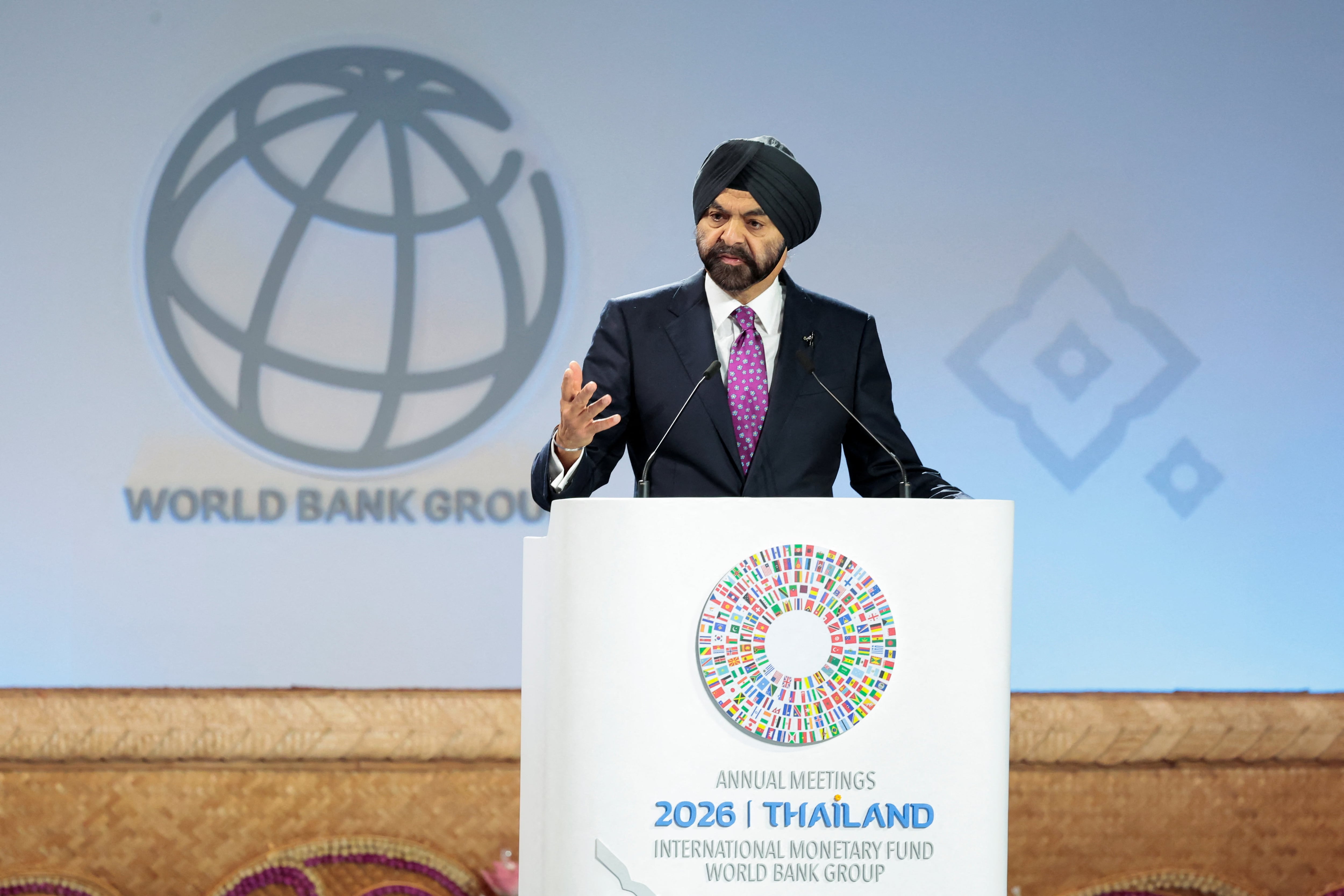
Pakistan's Minister for Economic Affairs, Ahad Khan Cheema, attended the 2026 WBG-IMF Annual Meetings in Bangkok. During the event, Cheema met with WBG President Ajay Banga to discuss deepening Pakistan's partnership with the World Bank Group. Separately, the ministry announced that Cheema was named the incoming Chair of the Boards of Governors for both the World Bank Group and the IMF for 2027. The ministry described this chairmanship as a 'historic milestone,' noting it marks Pakistan's return to the role after 1953. Discussions with WBG officials focused on achieving sustainable, investment-led growth and improving livelihoods.
World View
2 perspectivesIndia's perspective
LiveMint
Pakistan's Minister for Economic Affairs, Ahad Khan Cheema, was formally announced as the incoming Chair of the Boards of Governors for both the World Bank Group and the IMF for 2027 during the 2026 Annual Meetings in Bangkok. The coverage highlights that this appointment marks a significant return to the chairmanship for Pakistan, dating back to 1953. The ministry described the role as a 'historic milestone' and noted that the chairmanship will provide Islamabad with an opportunity to participate in global discussions on economic and development issues. Furthermore, the sources mention that the Minister met with WBG officials to exchange views on the role and its stewardship, alongside discussing the country's participation in global economic dialogue.
Pakistan's perspective
ARY News
The coverage from Pakistan details that the Federal Minister for Economic Affairs, Ahad Khan Cheema, met with WBG President Ajay Banga in Bangkok to discuss deepening Pakistan's partnership with the World Bank Group. The discussions focused on translating macroeconomic stabilization into sustainable, investment-led growth, productive employment, and improved livelihoods. The Minister highlighted Pakistan's own whole-of-government reform efforts to address systemic bottlenecks and expedite project execution. Both sides agreed to build on these efforts by further streamlining processes and strengthening operational effectiveness. Overall, the sources emphasize the importance of aligning policy reforms with large-scale investments to expand productive capacity and stimulate private investment.
The Hidden Strings
Patterns visible only when every country's coverage is placed side by side — the connections no single source draws.
Vocabulary
The Vocabulary String: Material Growth vs. Institutional Status
100%
The two narratives employ fundamentally different vocabularies to describe the same event. Cluster A focuses on tangible, material outcomes using terms like 'jobs,' 'growth,' and 'investment,' framing the meeting as an economic opportunity. Conversely, Cluster B uses abstract, high-status institutional language such as 'chairmanship,' 'boards,' and 'historic milestone,' emphasizing geopolitical legitimacy rather than immediate economic benefit.
Cluster A: 'jobs,' 'growth,' 'investment,' 'deepen partnership'Cluster B: 'chairmanship,' 'world bank,' 'historic milestone,' 'boards'
Frame Inversion
The Frame Inversion: Opportunity vs. Achievement
95%
The two clusters frame the same event using opposing lenses. Cluster A frames the meeting as a forward-looking, mutual 'opportunity' for economic improvement (deepen partnership). Cluster B, conversely, frames the meeting as a retrospective 'achievement',a historic milestone of restored institutional legitimacy and status (chairmanship). The narrative shifts from potential gain to confirmed status.
Cluster A: 'deepen partnership,' 'growth,' 'jobs,' 'investment'Cluster B: 'historic milestone,' 'chairmanship,' 'appointment'
Silence
The Silence on Institutional Scope
90%
Cluster A, which focuses on the economic partnership, completely omits the high-level institutional significance of the meeting. Despite the event involving World Bank leaders, the narrative only mentions 'growth, jobs and investment,' failing to acknowledge the geopolitical weight or the specific institutional bodies (IMF, World Bank boards) that are central to the discussion. This omission minimizes the diplomatic stakes.
Cluster A: 'Pakistan and World Bank Group to deepen partnership on growth, jobs and investment'Cluster B: 'Pakistan gets 2027 chairmanship of IMF, World Bank boards after 74 years'
Timing
The Narrative Delay: Economics First, Status Second
90%
The reporting timeline suggests a strategic sequencing of narratives. The economic angle (Cluster A) is released first (15:09), establishing a narrative of immediate, bilateral economic necessity. The highly significant diplomatic status update (Cluster B) is released three hours later (18:26), allowing the initial economic frame to set the stage before the geopolitical weight is applied.
2026-10-16T15:09 Pakistan ARY News: Pakistan and World Bank Group to deepen partnership on growth, jobs and investment2026-10-16T18:26 India LiveMint: Pakistan gets 2027 chairmanship of IMF, World Bank boards after 74 years, calls appointment ‘historic milestone’
How Each Side Framed It
Economic partnership and mutual growth
Pakistan
Favors Pakistan's economic stability and international cooperation.
deepen partnershipgrowthjobsinvestment
Historical diplomatic achievement and legitimacy
India
Neutral, focusing on Pakistan's return to global leadership.
chairmanshipimfworld bankhistoric milestone
What Mainstream Coverage Missed
Angles present in the cross-border material that the dominant coverage buried or skipped.
- The specific institutional significance of the meeting, involving the Boards of Governors for both the IMF and the World Bank, is minimized in the economic coverage.
- The narrative delay suggests a strategic sequencing, where the immediate economic necessity was established before the high-status diplomatic achievement was announced.
- The differing vocabularies,'jobs' versus 'chairmanship',reveal a fundamental split between discussing material economic needs and confirming geopolitical status.
The Beyond the Borders PoV
The Question
Pakistan should prioritize structural reforms and deepen its economic partnership with the World Bank Group to achieve sustainable, investment-led growth.
Pakistan should prioritize structural reforms and deepen its economic partnership with the World Bank Group to achieve sustainable, investment-led growth.
Pakistan is currently engaged with the IMF under significant lending facilities, and the country is scheduled to chair the Boards of Governors of both the IMF and the World Bank Group in 2027. Furthermore, the government has committed to strengthening the private sector, including a target to double SME financing by 2028, while prioritizing key sectors like digital transformation and energy infrastructure.
Deepening the partnership with the World Bank Group is necessary because the WBG has demonstrated significant operational improvements, such as reducing average project preparation time from 19 months to nine months, and mobilizing US$112 billion in private capital, which directly supports the goal of investment-led growth.
The commitment to structural reforms, such as doubling SME financing by 2028 and prioritizing sectors like digital transformation and energy infrastructure, provides a clear domestic roadmap that aligns with the WBG's goal of achieving sustainable, investment-led growth.
The upcoming chairmanship of the IMF and World Bank Group in 2027 provides Pakistan with a unique platform to champion its structural reforms and global economic agenda, thereby maximizing the benefits of its current financial engagements with the IMF.
These are AI-generated arguments built from the evidence available across the source material. They do not imply that any publisher endorses either position.
Disclaimer
The summary and perspectives above are AI-generated from the source articles listed below. They may contain errors or omissions. Always verify with the original sources. Beyond the Borders is a news aggregation platform and does not produce original journalism.
How does this story make you feel?
What each source is saying
2 sourcesTheir Angle
Pakistan's Ministry of Economic Affairs announced that Ahad Khan Cheema was named the incoming Chair of the Boards of Governors for the World Bank Group and IMF for 2027. This appointment, made during the 2026 Annual Meetings in Bangkok, is described as a 'historic milestone' for Pakistan, marking its return to the chairmanship after 1953.
Full Article
Pakistan will take over as chair of the Boards of Governors of the International Monetary Fund (IMF) and the World Bank Group (WBG) in 2027, marking its return to the position after more than seven decades, the country's Ministry of Economic Affairs said on Friday. Ahad Khan Cheema, Pakistan's Minister for Economic Affairs and its governor to the World Bank, was named the incoming chair during the plenary session of the 2026 WBG-IMF Annual Meetings in Bangkok. Describing the appointment as a "historic milestone", the ministry said the role would give Islamabad an opportunity to participate in global discussions on economic and development issues and encourage constructive engagement among member countries.“At the Plenary Session of the 2026 #IMFWBGMeetings2026 in Bangkok, Federal Minister for Economic Affairs and Governor WBG, Mr. @AhadKhanCheema1 was formally announced as the Chair of the Boards of Governors of the World Bank Group and IMF for 2027,” Pakistan's Ministry of Economic Affairs wrote on X.“This marks a significant milestone for Pakistan, returning to the Chairmanship for the first time since 1953. The Minister also met Ms. Aradhana Kumar-Capoor, WBG Vice President and Corporate Secretary, and Mr. Carlos Carvallo Spalding, outgoing Chair, to exchange views on the role and its stewardship,” it added.“Pakistan will seek to foster inclusive dialogue, amplify the perspectives of developing economies, and advance a more responsive multilateral development and financial system,” it further said. Pakistan's engagement with the IMF and loan programmesThe IMF-WBG annual meetings, being held from October 12 to 18, have brought together more than 15,000 participants from 191 countries. Pakistan is engaged with the IMF under a USD 7 billion Extended Fund Facility (EFF) and a USD 1.4 billion Resilience and Sustainability Facility (RSF). Pakistan is using funds under the Extended Fund Facility (EFF) to meet its balance-of-payments requirements and advance economic reforms. The Resilience and Sustainability Facility (RSF), meanwhile, offers longer-term financial support to help the country mitigate climate-related risks and improve its ability to withstand them. The country could receive around $1.2 billion from the IMF, subject to clearance by the Fund's Executive Board, following an agreement between IMF staff and Pakistani authorities on the latest reviews of both lending programmes.
More from business

PreviousbusinessWorld Bank Targets Fivefold Growth in Critical Minerals Financing by 2030NextindiaBMC Demolishes Part of Ajay Devgn's Juhu Bungalow Over Unauthorized Construction
Discussion
Leave a comment