Trump Urges Zelenskyy Replacement Amid Diesel Deal with Russia
October 12, 2026 at 2:22 AM1 min read

AI Summary
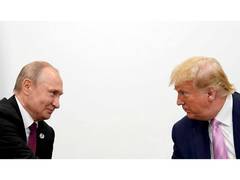
Donald Trump called for Ukraine to select a new leader on Saturday, following an announcement that the US would allow large amounts of Russian diesel onto global markets. Trump accused President Volodymyr Zelenskyy of blocking a deal with Moscow and ignoring instructions not to strike Russian refineries. Zelenskyy, meanwhile, criticized the US decision, calling it a “weak decision” and linking the easing of sanctions to a Russian attack that killed at least 20 to 21 people in Ukraine. The dispute occurred as global diesel prices rose, creating a political liability for Trump’s Republican Party.
World View
2 perspectivesPakistan's perspective
ARY News
Sources emphasize that Donald Trump called for Ukraine to select a new leader following the US decision to allow large amounts of Russian diesel onto global markets. Trump accused President Zelenskyy of blocking a potential deal with Moscow and ignoring instructions not to strike Russian refineries. Meanwhile, Kyiv and its European allies expressed dismay, warning that easing sanctions on Russia would undermine efforts to end the war. The dispute occurred amid rising global diesel prices, which are noted as a political liability for Trump’s Republican Party ahead of upcoming elections. Zelenskyy criticized the US move, calling it a “weak decision” after reports of recent Russian attacks in Ukraine.
India's perspective
DD News
The coverage reports that Donald Trump called for Ukraine to replace its leader, Volodymyr Zelenskyy, following the announcement of a diesel supply deal with Russia. Trump criticized Zelenskyy for striking Russian oil infrastructure, arguing that the actions hurt global diesel supplies and created problems for farmers and ranchers. Zelenskyy, in turn, sharply rebuked the US decision, linking the lifting of sanctions on Russian diesel to a Russian attack that killed 20 people in Zaporizhzhia. The articles note that the rising global diesel prices are a political liability for Trump’s Republican Party as it approaches midterm elections.
Analysis
Both sources report Trump's call for Zelenskyy's replacement and the US agreement for Russian diesel. Source 1 states the latest Russian attacks killed at least 21 people, while Source 2 specifies 20 people, including 3 children, in Zaporizhzhia. Source 1 mentions Trump's defense of the deal was partly because of soaring energy costs, while Source 2 notes this rise in prices is a political liability for the Republican Party ahead of midterms.
The Hidden Strings
Patterns visible only when every country's coverage is placed side by side — the connections no single source draws.
Vocabulary
The Vocabulary String: Geopolitical Conflict vs. Economic Drama
100%
Cluster A utilizes highly specific, loaded vocabulary related to the Russia-Ukraine conflict (e.g., 'russian,' 'refineries,' 'strikes,' 'moscow'). Conversely, Cluster B, despite covering the same core event, is entirely silent on these terms, focusing only on the localized political and economic terminology like 'diesel row' and 'replacement.' This reveals a deliberate choice to frame the event either as a global conflict or a regional political dispute.
Contrast table: 'russian' used by [Geopolitical conflict over energy deals] but ABSENT in [Political drama over diesel deal]Contrast table: 'refineries' used by [Geopolitical conflict over energy deals] but ABSENT in [Political drama over diesel deal]Cluster A: 'tussle, railed against, sharp rebuke, attacks on russian oil infrastructure'Cluster B: 'urges, replacement, diesel row rages'
Silence
The Silence String: Omission of the War Context
95%
The most striking pattern is the systematic omission of the underlying geopolitical conflict by the second source. While the initial report (India/DD News) grounds the event in the context of the Russia-Ukraine war, the subsequent report (Pakistan/ARY News) completely ignores this global conflict, focusing solely on the immediate, localized 'diesel row.' This suggests a narrative narrowing designed to de-escalate the perceived global stakes.
Contrast table: 'zelenskyy' used by [Geopolitical conflict over energy deals] but ABSENT in [Political drama over diesel deal]Contrast table: 'ukraine' used by [Geopolitical conflict over energy deals] but ABSENT in [Political drama over diesel deal]Cluster B: 'diesel row rages'2026-10-11T06:12 Pakistan ARY News: Trump urges Zelensky replacement as diesel row rages
Timing
The Timing String: Rapid, Divergent Framing
90%
Both sources publish their reports within a tight 12-minute window (06:00 and 06:12), indicating a rapid, coordinated response to the same core news event. However, the timing is used to deploy two fundamentally different narratives: the first establishes the high-stakes geopolitical context, while the second immediately pivots to a more contained, politically charged, and less threatening regional drama.
2026-10-11T06:00 India DD News: Trump calls for replacing Ukraine’s Zelenskyy in tussle over diesel deal with Russia2026-10-11T06:12 Pakistan ARY News: Trump urges Zelensky replacement as diesel row rages
How Each Side Framed It
Geopolitical conflict over energy deals
India
The framing emphasizes the political conflict and instability within Ukraine.
tusslerailed againstsharp rebukeattacks on russian oil infrastructure
Political drama over diesel deal
Pakistan
The framing focuses on the immediate political conflict and instability surrounding the deal.
urgesreplacementdiesel row rages
What Mainstream Coverage Missed
Angles present in the cross-border material that the dominant coverage buried or skipped.
- The dispute is framed not just as a conflict over diesel, but as a political liability for Trump’s Republican Party.
- The two sources employ fundamentally different vocabularies, deliberately choosing to frame the event either as a global conflict or a localized political dispute.
- The second source systematically omits the underlying geopolitical conflict, focusing solely on the immediate, localized 'diesel row' to de-escalate the perceived global stakes.
The Beyond the Borders PoV
The systematic narrowing of the narrative proves that the goal is not reporting the conflict, but managing its perceived global scale.
The stark contrast between the geopolitical vocabulary and the localized 'diesel row' framing is highly revealing. By systematically omitting the war's global context, the second source de-escalates the narrative from a high-stakes conflict to a manageable domestic political spat. This pattern suggests an incentive to contain the story, transforming a global liability into a regional dispute. The silence is consistent with a desire to limit international scrutiny and prevent the issue from becoming a sustained geopolitical crisis. The media machinery thus prioritizes narrative containment over comprehensive reporting.
This is our editorial interpretation of the cross-source evidence above, not a report of established fact. The sourced coverage it draws on is listed below.
Disclaimer
The summary and perspectives above are AI-generated from the source articles listed below. They may contain errors or omissions. Always verify with the original sources. Beyond the Borders is a news aggregation platform and does not produce original journalism.
How does this story make you feel?
What each source is saying
2 sourcesTheir Angle
Donald Trump called for Ukraine to get a new leader after Zelenskyy criticized the US easing of Russian diesel sanctions. Trump defended the deal, accusing Zelenskyy of blocking a deal with Moscow and ignoring instructions not to strike Russian refineries. The row followed Russian attacks across Ukraine that killed at least 21 people, including children.
Full Article
WASHINGTON: Donald Trump called on Saturday for Ukraine to “get a new leader” after Volodymyr Zelensky slammed Washington’s easing of Russian diesel sanctions, as the US president faces fuel price pressure weeks before midterm elections. Trump, whose Republicans face dim prospects in next month’s vote partly because of soaring energy costs, defended a deal allowing more Russian diesel onto global markets after saying Vladimir Putin wanted “strongly” to reach a settlement in Ukraine. Trump accused the Ukrainian president of blocking a deal with Moscow and ignoring instructions to not strike Russian refineries, while Kyiv and its European allies warned that easing pressure on Moscow would help fund the Kremlin’s war. The row unfolded as the latest Russian attacks across Ukraine killed at least 21 people, including children. Trump announced Friday that he had spoken to Putin and agreed for Russia to release large amounts of diesel into world markets. Ukraine and its European allies expressed dismay, with Zelensky telling reporters Friday it was a “weak decision.” Asked about the criticism, Trump said Zelensky had disobeyed his orders not to strike Russian refineries and that the attacks risked worsening fuel shortages linked to the US-Israeli war on Iran. “I suggest they get a new leader who can make a deal, because he could have made many deals that, for some reason, he never does,” Trump said. “Russia would like to make a deal… but for whatever reason, Zelensky does not want to make a deal,” he told reporters. The US president also criticised Zelensky for not holding an election since Russia’s invasion in 2022. “I think he should have an election, and he could have settled this thing many times,” Trump said. EU foreign policy chief Kaja Kallas said lifting sanctions on Russian diesel would only help sustain Russia’s war effort. “This is not the time to ease pressure on Russia, and Europe won’t,” she wrote online. UK Prime Minister Andy Burnham reiterated his “complete solidarity” with Zelensky in a call. Downing Street said Burnham also pledged that Britain would “strengthen its sanctions on Russia”. Ukraine’s Foreign Minister Andriy Sybiga also backed his president. “He has the support of the Ukrainian people, and they have the right to decide,” he said in a post on X. On Saturday, a Russian glide bomb attack on the southeastern city of Zaporizhzhia killed 20 people, including three children, according to Ukraine’s state rescue service. “Today, Russia expressed its thanks for the lifting of sanctions on diesel exports by dropping five glide bombs on residential buildings in Zaporizhzhia,” Zelensky said in a post on X. An AFP correspondent saw rescue workers pulling survivors and bodies from the rubble. “We saw people under the rubble — a woman, her husband and a child,” one rescuer, Daniil Pishkin, told AFP. He said two people were rescued alive, but “unfortunately there was a little girl who died”. A resident identified as Iryna, 69, said she managed to shelter in her bathroom after receiving an air-raid alert. “They were 75 years old. They were simply thrown out there, onto the street. They didn’t make it to the hospital,” she told AFP. A Russian drone attack in the central Dnipropetrovsk region killed an 11-year-old boy, regional officials said. Russia’s defense ministry said it had hit a “data center” used by Ukraine’s military. ISLAMABAD: Following approval of President Asif Ali Zardari, Governor’s rule and emergency have been enforced in Khyber Pakhtunkhwa (KP) to maintain law and order. As per details, the president has signed the summary for the imposition of an emergency and Governor’s Rule in Khyber Pakhtunkhwa under Articles 232 and 234 of the Constitution.
More from world
world
Trump Criticizes Zelenskyy Over Ukraine Conflict and Calls for Change
about 13 hours ago · 2 sources
world
US Jet Strikes Cargo Vessel in Gulf of Oman Amid Blockade Concerns
about 13 hours ago · 2 sources
world
Kremlin Spokesman Claims Zelensky Would Engage in Peace Talks
about 13 hours ago · 2 sources
Discussion
Leave a comment